
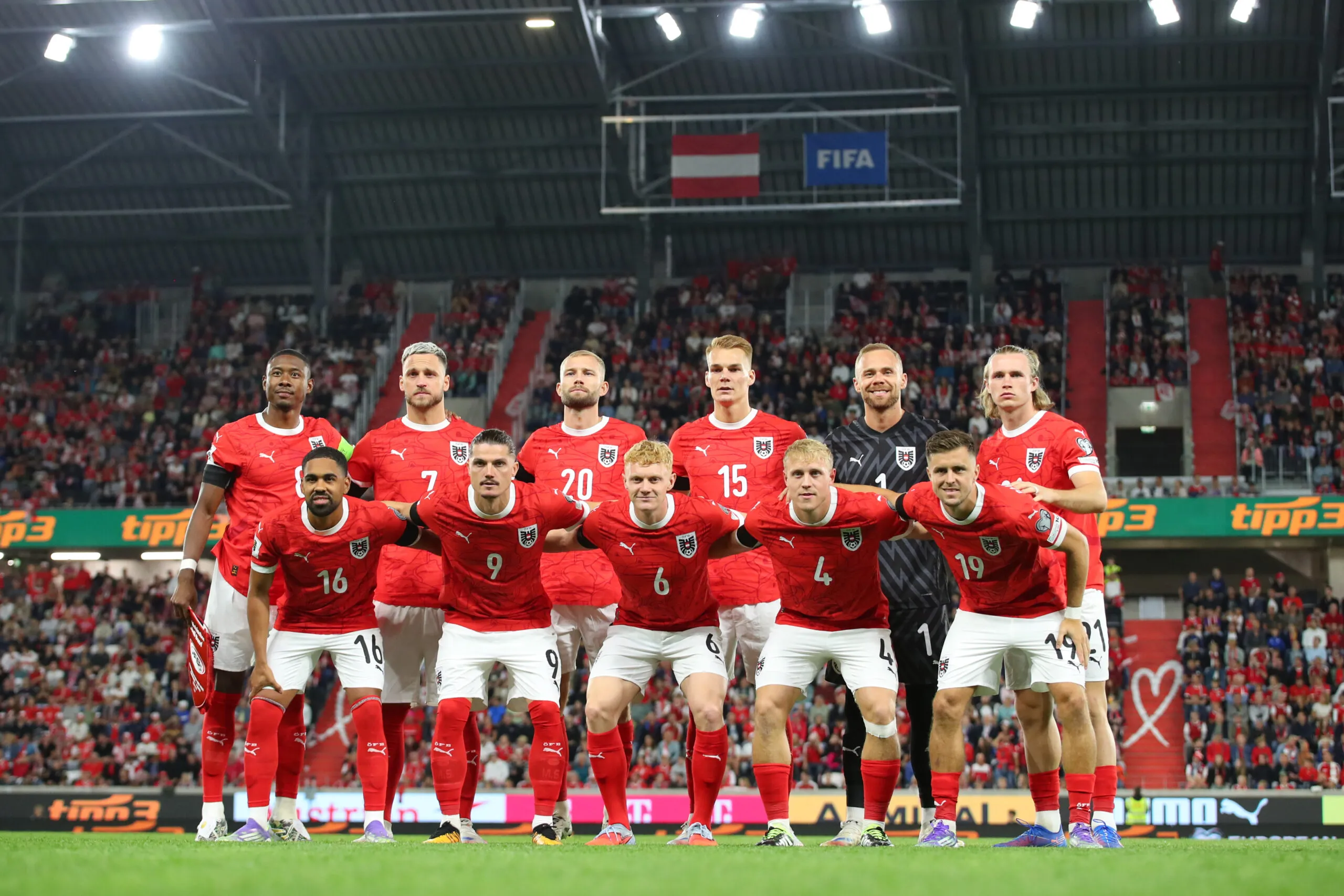
Austria has officially confirmed its final squad for the 2026 FIFA World Cup, launching a high-stakes campaign to capture the nation’s first-ever major international trophy. Under the astute tactical guidance of manager Ralf Rangnick, Das Team punched their ticket to North America by impressively winning Group H ahead of runners-up Bosnia and Herzegovina and third-placed Romania.
While Austria boasts a rich footballing history with seven previous World Cup appearances, this tournament represents a massive milestone. The European side has not featured at a World Cup finals since France 1998, a tournament where they suffered a disappointing group-stage exit. Though their historical pinnacle came with a third-place finish back in 1954, Rangnick’s modern, high-pressing outfit crosses the Atlantic with aspirations of venturing beyond the semi-finals for the first time in history.
Schlager Claims the Number One Jersey
Between the posts, Alexander Schlager has firmly established himself as Austria’s first-choice goalkeeper. The Red Bull Salzburg shot-stopper, who possesses 24 international caps, successfully held off fierce competition from Brondby’s Patrick Pentz (17 caps) to claim the starting role.
Viktoria Plzen’s Florian Wiegale travels as the designated third-choice goalkeeper, securing his place on the plane ahead of Genk’s Tobias Lawal, who narrowly missed out on final selection.
Alaba Commands an Experienced Defensive Line
The undeniable centerpiece of the Austrian backline is team captain David Alaba. The Real Madrid icon stands as one of the most decorated footballers in the history of the sport, and his wealth of experience—spanning well over 100 international caps—will be fundamental to Austria’s ambitions across the United States, Mexico, and Canada.
Partnering Alaba in central defense is Tottenham Hotspur’s Kevin Danso. Despite a catastrophic domestic campaign with Spurs that sees the London club facing a shocking relegation battle, Danso remains a vital cog in Rangnick’s system. The defensive unit is further bolstered by a core of seasoned Bundesliga performers, including Mainz 05 fullback Stefan Posch and Hoffenheim’s versatile Alexander Prass.
| Player | Club |
| David Alaba | Real Madrid |
| Marco Friedl | Werder Bremen |
| Kevin Danso | Tottenham Hotspur |
| Stefan Posch | Mainz 05 |
| Philipp Lienhart | SC Freiburg |
| Phillipp Mwene | Mainz 05 |
| Alexander Prass | Hoffenheim |
| Michael Svoboda | Venezia |
| David Affengruber | Elche |
Youthful Wildcards Complement a Bundesliga-Centric Midfield
Rangnick’s midfield engine room is heavily underpinned by the tactical discipline of Germany’s Bundesliga, a competition famous for its grueling, high-intensity pressing demands. Borussia Dortmund maestro Marcel Sabitzer brings his 95 caps of elite experience to the setup alongside RB Leipzig’s exceptional holding midfielder Xaver Schlager, who is closing in on his 50th international appearance. Bayern Munich’s versatile Konrad Laimer adds further tactical flexibility, capable of slotting seamlessly into midfield or anchoring the right side of defense.
However, the headline story of Austria’s midfield selection lies in its youth injection. In a major coup for the Austrian FA, 20-year-old Borussia Dortmund starlet Carney Chukwuemeka officially pledged his international future to Austria over England. He is joined by fellow 20-year-old prodigy Paul Wanner, who enters the tournament following an outstanding breakthrough season in the Eredivisie with PSV.
| Player | Club |
| Xaver Schlager | RB Leipzig |
| Nicolas Seiwald | RB Leipzig |
| Marcel Sabitzer | Borussia Dortmund |
| Florian Grillitsch | Braga |
| Romano Schmid | Werder Bremen |
| Christoph Baumgartner | RB Leipzig |
| Konrad Laimer | Bayern Munich |
| Patrick Wimmer | VfL Wolfsburg |
| Alessandro Schopf | Wolfsberger AC |
| Carney Chukwuemeka | Borussia Dortmund |
| Paul Wanner | PSV |
Arnautovic’s Final Dance Headlines the Attack
The responsibility for leading the line falls squarely on the broad shoulders of Marko Arnautovic. The 36-year-old former Stoke City and West Ham United striker now features for Red Star Belgrade but remains as lethal as ever in front of goal for his country. Boasting more than 130 caps and a spectacular tally of 47 international goals, this tournament is widely anticipated to be the veteran’s final major swansong for his homeland.
Reliable attacking reinforcements and physical options from the bench are provided by Augsburg’s Michael Gregoritsch and LASK center-forward Sasa Kalajdzic.
| Player | Club |
| Marko Arnautovic | Red Star Belgrade |
| Michael Gregoritsch | Augsburg |
| Sasa Kalajdzic | LASK |
Core Strengths and Key Tactical Catalyst
For Austria to successfully navigate the group stages and progress deep into the knockout rounds, their spine will need to perform flawlessly. Up front, Arnautovic must maintain his clinical edge to convert the team’s high-turnover opportunities into goals.
In the center of the pitch, Sabitzer will act as the on-field orchestrator, anchoring the team’s tactical shape and demanding structural discipline from his teammates. On the flanks, Chukwuemeka represents an unpredictable, highly explosive wildcard option; though he enters the tournament hunting for his first senior cap, his individual brilliance could see him announce himself as a global superstar. Finally, the defensive line will rely completely on the composure and big-game pedigree of David Alaba to absorb elite international pressure.